

Undisturbed observation means that animals are observed from a distance with the least possible disruption. Ideally, undisturbed observation is carried out with a camera in the animal room while viewing the images in another room. This cannot always be done. In that case, the observer will have to enter the animal room as quietly as possible and wait a while prior to starting the observation. Once it is clear that the fish no longer respond to the observer’s presence—because they are swimming calmly and, for example, are not positioned where they expect food—observation can begin.
Zebrafish that are chronically stressed or ill show a range of abnormalities in appearance or behaviour, depending on the cause (see figure below). The diagram lists the major changes that occur as a result of disease or poor water quality, inadequate housing or bad management. Changes can also be caused by induced genomic mutations (the mutant’s phenotype).
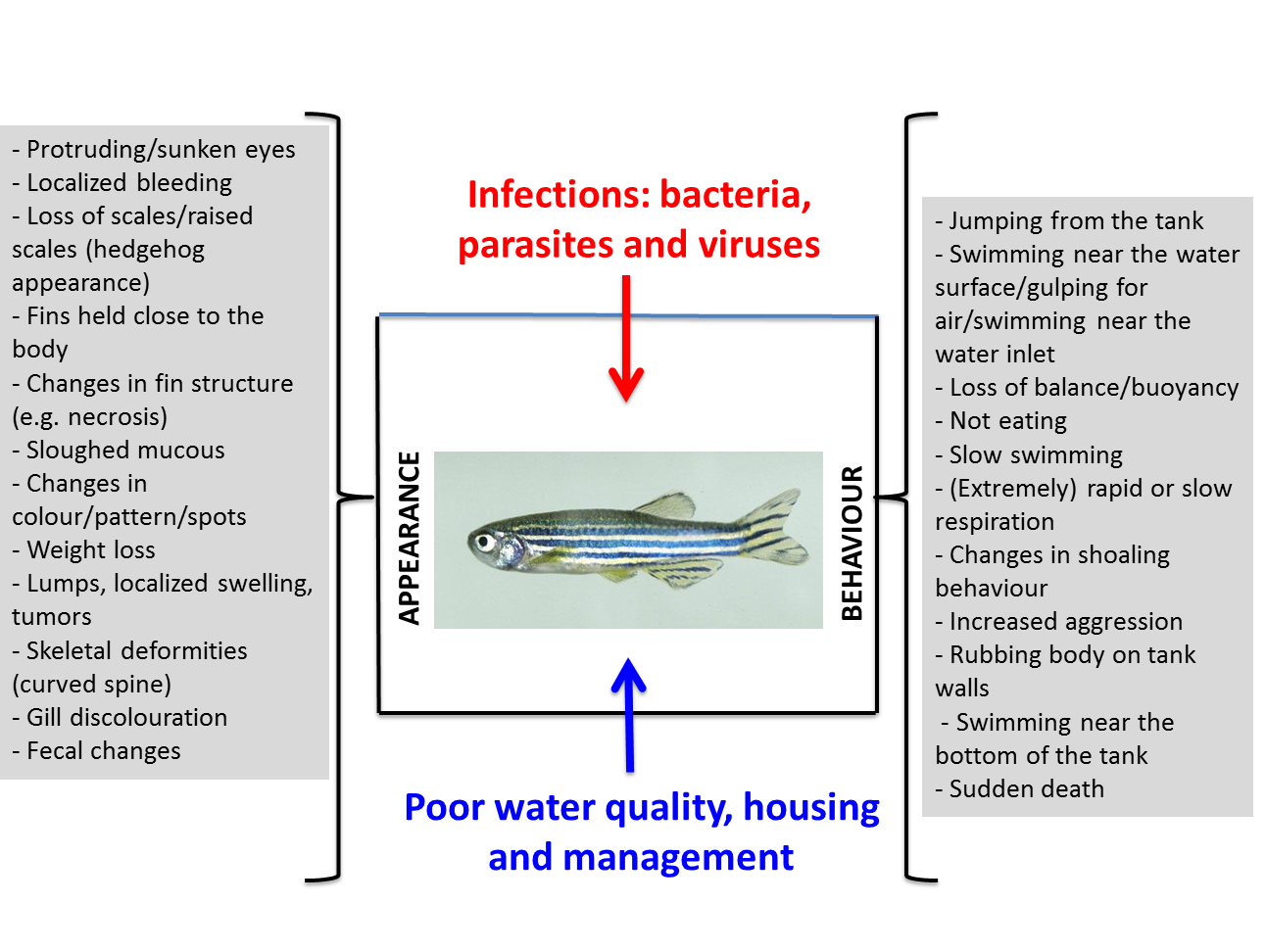
Aspects that should be assessed include:
- Activity and location: A healthy zebrafish is active but also has rest periods. Zebrafish swim throughout the entire water column. They are diurnal animals: their active period is during daylight. Aberrant behaviour will be more noticeable and more pronounced during the active period. Where relevant, it is advisable to observe animals during the dark period as well. This can be done using infrared or dimmed lighting.
- Social interaction: Is the social interaction normal or abnormal? E.g., fighting or withdrawal from the shoal.
- Alertness: An alert zebrafish explores and assesses its environment. How the fish responds to changes is an indication of its alertness. For instance, they respond to presented food or to a tap on the tank.
- Abnormal behaviour: Examples of abnormal behaviour are inability to maintain balance, excessive activity, or very rapid respiration.
- Abnormal appearance: Examples of abnormal appearance are deformities or abnormal development (e.g., tumoursTumor Neoplasm, new growth. Is predicated upon autonomous growth of cells or tissues into benign or malignant tumors., severe weight loss (figure 1), and skeletal deformities (scoliosisScoliosis Sideways curving deformity of the spine. It may be caused by a bone growth disorder, but may also be the result of abnormal contraction or loss of tension in the muscles surrounding the spine, e.g., following a tetanus infection that affects one side of the body only., figure 2).
During undisturbed observation, conditions in the housing environment should also be taken into account (for example, abnormal lighting conditions or unusual sounds).
